
1. For the longest time, healthcare has revolved around encounters, not continuity
Traditional healthcare has been built around three essential layers:
Consultation. Diagnosis. Treatment.
A patient visits a doctor, undergoes a clinical assessment, receives a diagnosis and is prescribed treatment.
These three layers have formed the foundation of healthcare delivery for generations. They are essential, and they will always remain so.
But the way healthcare is organised around these encounters has one fundamental limitation.
Healthcare delivery has largely focused on the moments when a patient meets a healthcare provider — not on the entire period during which the patient needs care.
Consider a child recovering from fever. The consultation may last fifteen minutes, but recovery takes place over several days.
A newborn may visit the paediatrician periodically, but feeding, growth and development continue every day.
A child with asthma may receive a treatment plan during a consultation, but managing the condition requires attention between visits.
In each case, the clinical encounter is important. Yet much of the child's healthcare journey unfolds outside the clinic.
Traditionally, that period has depended heavily on parents following instructions, observing changes and reaching out when they believe medical attention is needed.
What has often been missing is a structured connection between the doctor's clinical decisions and the care taking place at home.
Introducing the fourth layer: Continuous Care
Modern healthcare has the opportunity to move beyond a model organised primarily around individual encounters.
By adding Continuous Care as the fourth layer , healthcare can extend beyond consultation, diagnosis and treatment into the days, weeks or months when patients continue to need guidance, observation and support.
Continuous Care does not replace the three established layers.
It connects them to the patient's ongoing healthcare journey.

The first three layers establish the clinical direction. The fourth supports the care journey that follows.
From healthcare centred on encounters to healthcare connected across time.
2. Two very different ways of delivering paediatric care
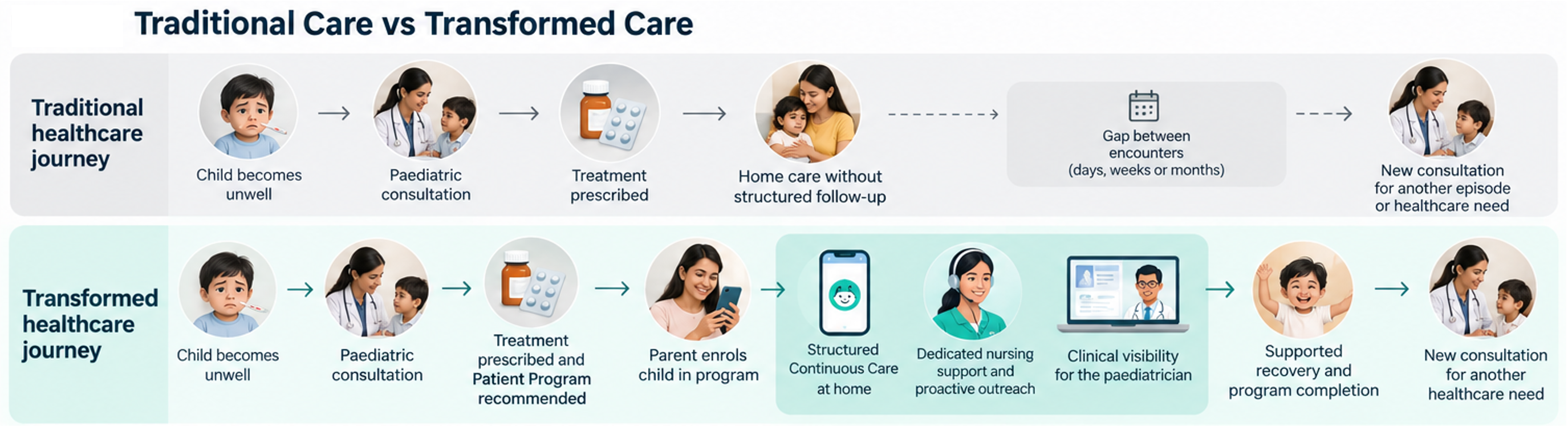
Consider a child who becomes unwell and visits a paediatrician.
The consultation, diagnosis and treatment may be exactly the same in two different models of healthcare delivery.
What changes is what happens after the child leaves the clinic.
Traditional care: A series of separate encounters
The child becomes unwell. The parent visits the paediatrician. The doctor assesses the condition and prescribes treatment.
The family returns home.
The parent follows the instructions, administers prescribed medicines and observes the child's progress.
If questions arise or symptoms change, the parent may contact the clinic, seek another consultation or decide whether further medical attention is necessary.
The child may recover without requiring another visit.
Weeks or months later, a new illness or healthcare need may arise, prompting another consultation.
The next healthcare encounter begins.
In this model, the period between consultations may have little structured connection to the practice , even though important care activities are taking place at home.
Transformed care: Connected journeys of care
Now consider the same child in a healthcare model that includes Continuous Care.
The child becomes unwell and visits the paediatrician.
The doctor assesses the condition, makes the clinical decisions and prescribes treatment, just as before.
The doctor also recommends a MyGleeo Patient Program to support the child's care beyond the consultation.
The parent enrols the child in the recommended program, and the care journey continues at home.
The parent receives structured guidance, reminders and planned check-ins through the MyGleeo app.
A dedicated nursing team, available 24×7, supports the family throughout the program. Nurses review relevant responses, proactively contact parents when concerns are identified and help address questions arising during the child's care.
The paediatrician has organised visibility into the child's reported condition and progress through a dashboard, without relying on repeated telephone calls and messages.
When a concern requires medical judgement, the nursing team escalates it to the treating paediatrician under agreed clinical protocols.
The child's recovery and care activities are supported and followed through during the program, with further clinical assessment or treatment when necessary.
When the program concludes, the family continues with ordinary care as appropriate.
Later, when another illness or healthcare need arises, a new consultation can begin another connected care journey.
The healthcare encounter is no longer an isolated event. It becomes the clinical starting point of a structured period of care.
The transformation, at a glance
Traditional: Child becomes unwell → Consultation → Treatment prescribed → Home care without structured follow-up → Gap between encounters → New consultation.
Transformed: Child becomes unwell → Consultation → Treatment and Patient Program recommended → Parent enrols child → Structured Continuous Care at home → Supported recovery and program completion → New consultation when needed.
It is about making care more connected during the periods when patients need it.
3. What fundamentally changes in this model?

From parents seeking help to care teams reaching out
In traditional care, communication after a consultation is often initiated by the parent.
The parent notices a concern, decides whether it is important and attempts to reach the clinic.
This places considerable responsibility on parents, particularly when they are uncertain about what is normal and what requires medical attention.
In a Continuous Care model, support does not depend entirely on the parent initiating contact.
Planned check-ins create opportunities for the care team to understand how the child is progressing.
When a program response indicates a concern, the dedicated nursing team can proactively contact the parent, gather further information, provide guidance within its scope and arrange clinical escalation when required.
Parents also have access to registered, trained paediatric nurses available 24×7 for care-related support.
Parents know they are not alone in caring for their child after the consultation.
They remain central to everyday care, but they have a structured support system around them.
From fragmented communication to organised clinical visibility
A paediatrician may receive updates about a child's progress through telephone calls, messages, photographs or conversations during subsequent visits.
These communications are useful, but the information may be fragmented.
The doctor may become aware of a concern only when a parent communicates it.
Continuous Care creates a more organised information flow.
Relevant observations, responses and check-ins are captured as part of the child's care journey and made available to the paediatrician through the MyGleeo dashboard.
The nursing team reviews relevant responses, supports routine engagement and brings matters requiring clinical attention to the doctor's notice under agreed protocols.
The paediatrician can stay informed about the child's reported progress without repeated back-and-forth calls.
This visibility is based on information recorded through the program. It does not replace clinical examination or constitute uninterrupted real-time medical monitoring.
From individual encounters to connected care journeys
The third change is more fundamental.
Healthcare begins to be organised around the patient's need for care over time, rather than primarily around the date of a consultation.
For a child recovering from an acute illness, the journey may last several days.
For a newborn, relevant care needs may extend over weeks and months.
For a child with an ongoing condition, care may involve repeated periods of guidance, observation and clinical reassessment.
These journeys differ in duration and clinical requirements.
The care plan does not have to lose its connection with the healthcare provider when the family leaves the clinic.
Structured guidance, parent participation, nursing support, information capture and appropriate clinical escalation become part of the continuing journey.
| Traditional approach | Continuous Care approach |
|---|---|
| Parents initiate contact when they need help | Planned check-ins and proactive nursing outreach |
| Doctors receive fragmented updates | Organised visibility into the child's care journey |
| Care is centred on individual visits | Care is connected across visits |
4. Each new healthcare need can begin another connected journey
Children do not experience healthcare as a single episode.
They grow, develop, recover from illnesses and encounter new healthcare needs over time.
A newborn may require feeding and early development support. Months later, the same child may need vaccination-related guidance. At another time, the child may develop an acute illness.
Each situation may require a different clinical assessment, treatment decision or care plan.
Continuous Care does not remove the need for those consultations.
Instead, it changes the role of the consultation within the wider healthcare journey.
A consultation can establish the clinical direction for a period of care that continues afterward.
When that period concludes, the child may no longer need active program support.
When another healthcare need arises, a new consultation can establish the next care journey, supported by another relevant Patient Program.
This creates a model in which healthcare continuity does not depend on keeping a child permanently enrolled in a program or continuously under observation.
It depends on having the ability to provide structured care during the periods when that support is needed.
Continuous Care should not mean unnecessary medicalisation of childhood or additional intervention where none is needed.
It should mean that, when care needs continue beyond a consultation, the healthcare delivery model is equipped to support them.
The consultation remains essential. What changes is the continuity of care that follows it.
5. Continuous Care changes what healthcare can deliver
Traditional healthcare has achieved extraordinary progress through better consultations, more accurate diagnoses and increasingly effective treatments.
Continuous Care builds on these achievements.
It recognises that a clinical decision is only one part of the patient's experience.
Instructions must be clearly understood. Medicines and care plans must be followed. Symptoms and progress must be observed. Parents' questions need timely answers, and changes in the child's condition need to be recognised and addressed appropriately.
For paediatric care, much of this responsibility traditionally rests with parents at home.
Continuous Care introduces a structured system to support these needs through planned check-ins, proactive nursing outreach, guidance for parents and timely escalation to the paediatrician when clinical attention is required.
For parents , it means reassurance that they have support beyond the clinic, with dedicated nursing assistance and proactive outreach when relevant program responses indicate concerns.
For paediatricians , it means organised visibility into the child's care journey, while routine engagement is supported by the nursing team and clinical decisions remain with the treating doctor.
For healthcare delivery , it means moving from a model centred primarily on individual encounters towards one that supports the patient's needs across time.
This is the opportunity represented by the fourth layer of healthcare.
Not more consultations for the sake of more consultations.
Not technology replacing the doctor.
Not continuous medical attention for every child.
But a structured connection between the care prescribed in the clinic and the care taking place at home.
That is the thinking behind Beyond the Visit™ .
Continuous Care is not simply another service added to healthcare. It represents an evolution in how healthcare can be delivered.
Explore a more connected model of paediatric care
MyGleeo brings Continuous Care into paediatric practice through doctor-led Patient Programs, structured care journeys and dedicated 24×7 nursing support.
Discover how this model could fit the healthcare needs of children in your practice.
Explore Patient Programs for My Practice →Your expertise stays at the centre. MyGleeo extends your reach.