

Why does care need to continue after the consultation?
A consultation is an important clinical encounter, but it is rarely the whole healthcare journey. Once a family leaves the clinic, medicines still have to be given, symptoms still have to be observed, feeding and activity still have to be assessed, and parents often have new questions as the child’s condition changes.
Consider a child seen for fever in the evening. The examination happens in the clinic, but the parent’s practical decisions happen later: Has the temperature reduced? Is the child drinking enough? Has a new symptom appeared? Is the response to treatment what was expected? The need for care continues even though the consultation has ended.

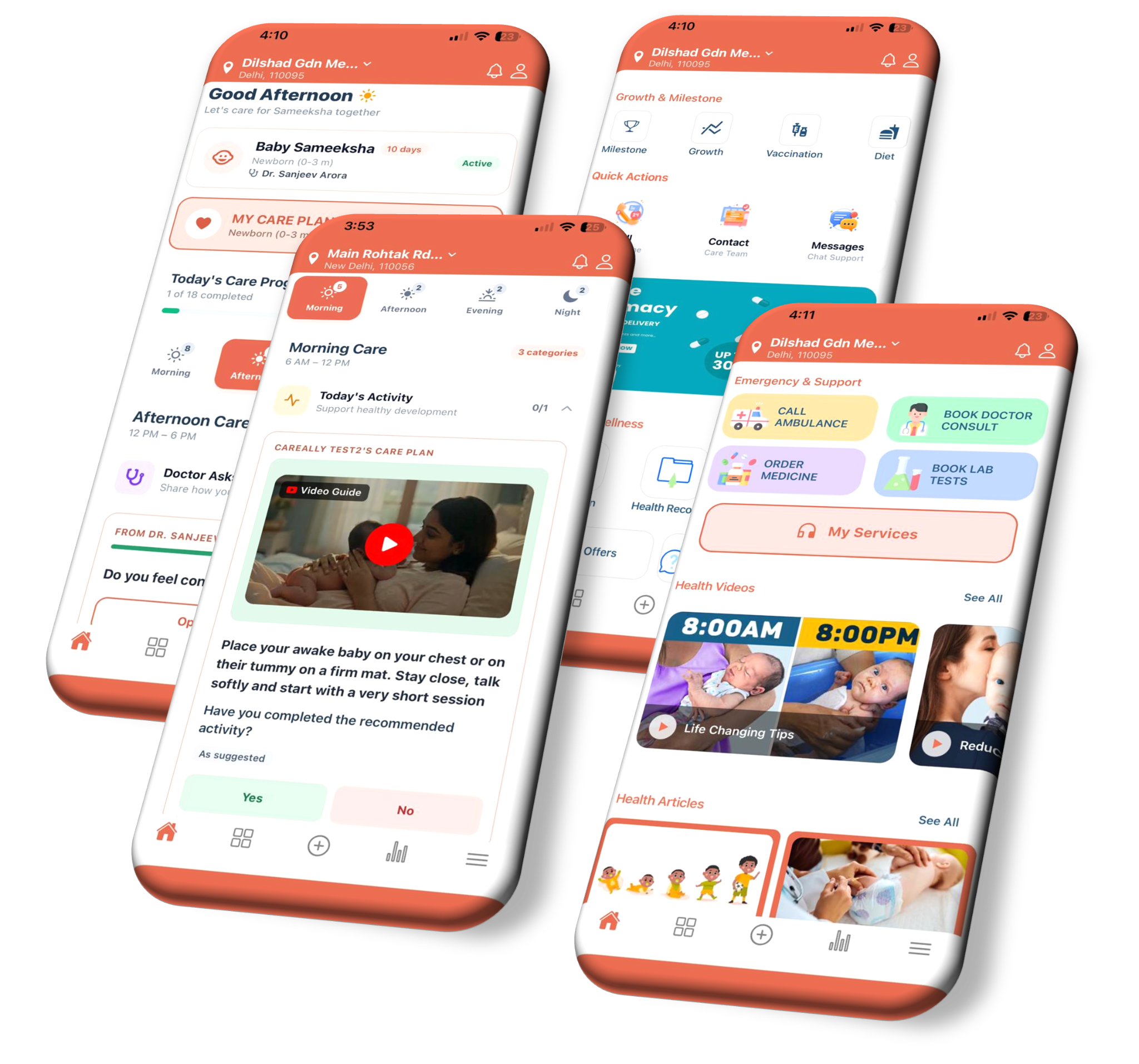
What exactly is a Patient Program?
A Patient Program is a structured outreach mechanism designed around one healthcare journey. Instead of leaving the period after a consultation unstructured, the program defines what the family needs to know, what should be monitored, how routine engagement happens and when the care team or doctor should become involved.
It is not simply a WhatsApp group, a collection of educational messages or another appointment. The purpose is to organise care beyond the encounter into a service that the practice can deliver consistently.
At MyGleeo, Patient Programs are powered by POINT™ - Patient Outreach Intervention Technology. POINT™ brings together the care elements that may be relevant to a journey; the Patient Program uses the appropriate combination of those elements as the outreach mechanism.
How does a Patient Program work in practice?
1. The paediatrician identifies the healthcare journey
The starting point remains the clinical encounter. The paediatrician identifies the child’s need and the appropriate journey - for example fever recovery, newborn care, vaccination, asthma or growth and development.
2. The parent enrols the child in the recommended program
The parent enrols the child in the recommended Patient Program, establishing the structured support that will continue after the consultation rather than relying on an open-ended promise to “call if needed.”
3. Structured care continues at home
Guidance and monitoring continue around the elements relevant to that journey. Families can provide simple updates and the care team can support routine engagement.
4. The doctor remains at the centre
Patient Programs are not designed to replace the paediatrician. Routine support can be handled through the program and care team, while clinical questions or concerns can return to the doctor when appropriate.
Who does what in a Patient Program?
Paediatrician
- Recommends the appropriate predefined Patient Program for the child.
- Receives relevant patient updates through the platform.
- Reviews clinical concerns escalated by the nursing team.
- Makes clinical decisions when doctor intervention is required.
MyGleeo platform & dedicated nursing team
- Provides predefined, journey-specific Patient Programs and the supporting app.
- Delivers structured program activities, guidance and questions to parents.
- Provides 24×7 first-level nursing support, monitors responses and addresses routine queries.
- Escalates clinical concerns to the paediatrician when required.
Parent
- Enrols the child in the recommended Patient Program.
- Uses the app on behalf of the enrolled child.
- Follows program guidance, completes activities and shares the child’s updates.
- Contacts the nursing team whenever support or clarification is needed.
The paediatrician recommends. The parent enrols. MyGleeo delivers the program with dedicated nursing support, keeping the doctor informed and involved when clinical intervention is needed.
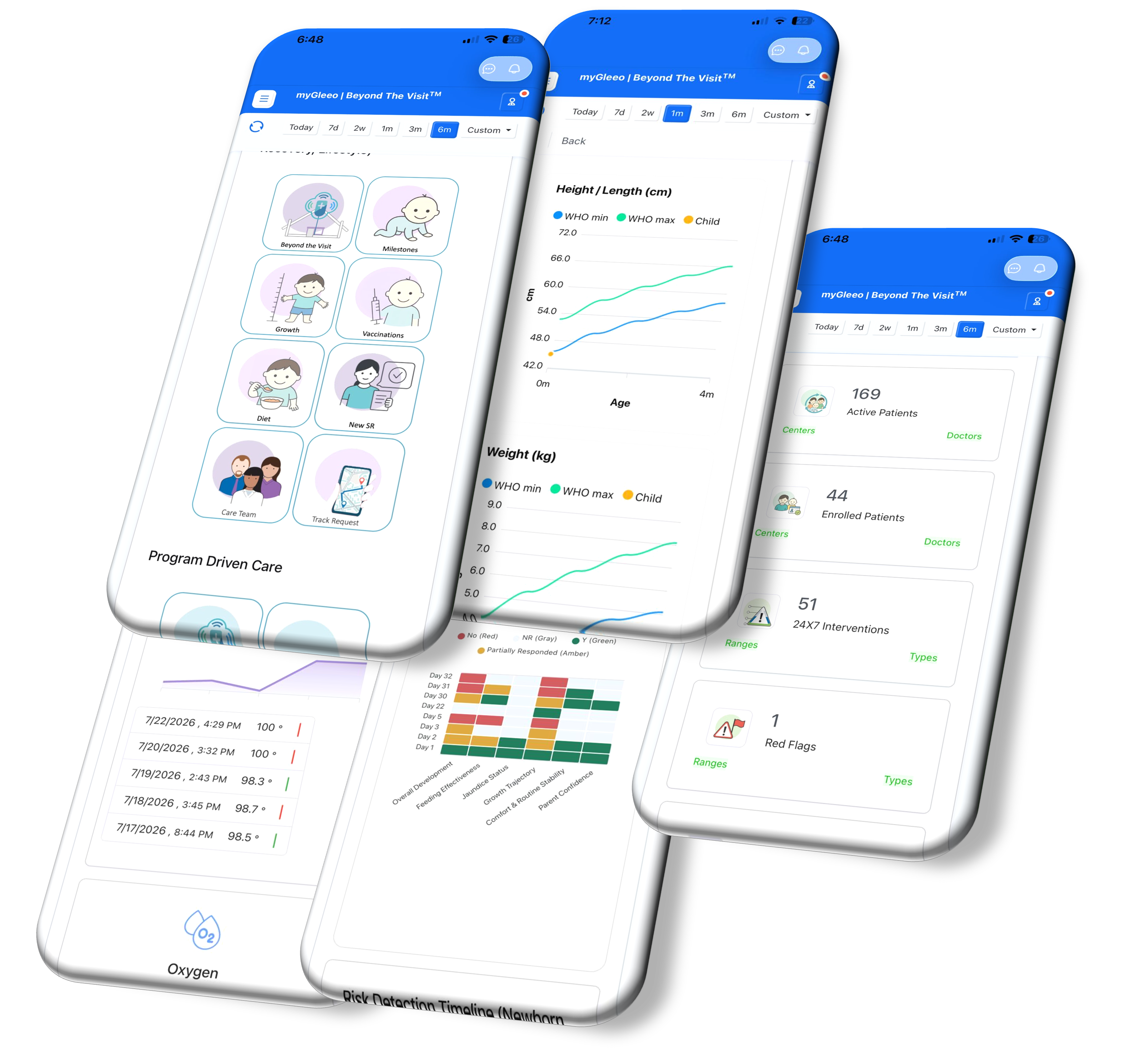
What can a Patient Program include?
Different healthcare journeys require different combinations of care. POINT™ brings together elements including Medicines, Activity, Vitals, Investigations, Recovery, Assessment and Diet. A Patient Program uses only the elements relevant to that particular journey.
For fever, the emphasis may be medicines, symptoms, hydration, activity and recovery. For a newborn, feeding, activity, weight-related observations, parent questions and assessment may be more relevant. Asthma may require a different combination again.
What healthcare journeys can Patient Programs support?
Patient Programs can support children across different ages, health needs and stages of development—from newborn care and routine childhood development to acute illnesses and long-term conditions.
MyGleeo offers predefined, journey-specific Patient Programs that paediatricians can recommend based on the child's healthcare needs.
Growth and development across childhood
Structured programs for newborns, infants, toddlers, preschoolers, school-age children and adolescents, supporting age-appropriate feeding, activity, growth, developmental milestones and parental guidance.
Acute illness and recovery
Programs for conditions such as fever, typhoid and other common childhood illnesses, supporting treatment adherence, symptom monitoring, recovery tracking and timely escalation when required.
Chronic and ongoing conditions
Programs for conditions such as asthma, obesity and chronic kidney disease, providing structured monitoring, guidance and continuity over longer periods.
Preventive care and vaccination
Programs supporting vaccination journeys, preventive health guidance, developmental surveillance and ongoing engagement with families.
The opportunity is not limited to a few conditions. Patient Programs can extend a paediatric practice's ability to serve children across a wide range of healthcare journeys, without requiring the doctor to personally manage every routine interaction.
Examples are illustrative. Program availability and suitability depend on the child's healthcare needs.
Defined journeys and planned check-ins
Organised updates for the paediatrician
24×7 nursing layer and escalation when needed
How is this different from ordinary follow-up?
Ordinary follow-up is often informal and dependent on the doctor or clinic staff remembering whom to contact. Patient Programs are intentionally structured: the journey, care elements, engagement and escalation pathway are defined in advance.
This distinction matters operationally. If care beyond the consultation depends entirely on the paediatrician personally answering every message, it does not scale. A structured program allows routine support to be organised while preserving the doctor’s role where clinical expertise is required.
Can Patient Programs support practice growth?
Yes, because they allow a practice to create a defined paid service around care that already exists beyond the consultation. That means growth does not have to depend only on fitting more consultations into the day.
The commercial principle is simple: the practice already has patients and trusted relationships. Patient Programs create a way to serve more of those families’ healthcare journeys. The service must still be valuable, clearly explained and appropriately operated; revenue is an outcome of delivering that additional value.
What makes Patient Programs practical for a busy paediatrician?
The operating model matters as much as the idea. MyGleeo combines the Patient Program with care support and technology so the paediatrician does not have to personally manage every routine interaction.
The doctor remains responsible for the clinical relationship. The supporting infrastructure helps the practice organise the work around that relationship - enrolment, routine engagement, structured updates and escalation when required.
This is why we describe MyGleeo as practice enablement rather than simply an app. Technology supports the service; it is not the service.
Questions paediatricians commonly ask
Does a Patient Program replace consultations?
No. It extends care beyond an encounter; it does not replace a consultation when a consultation is clinically required.
Does the doctor have to personally follow every patient?
The model is specifically designed to avoid that. Routine engagement can be supported by the care team and technology, with doctor involvement when clinically needed.
Is every program the same?
No. Each journey uses the relevant care elements. A newborn journey should not look like fever recovery or asthma management.
Can a practice charge for a Patient Program?
A Patient Program can be offered as a paid structured care service. The exact service, pricing and clinical scope should be clear to the family and appropriate to the practice.
What could care beyond the consultation look like for you?
We can explore the Patient Programs that fit your practice and the families you already serve.
Book a Call →