

Why consultation-led growth eventually hits a ceiling
A paediatrician has a finite number of clinical hours. If growth depends only on more OPD consultations, eventually the diary, the doctor’s energy or the physical clinic becomes the constraint.
This does not mean consultations are less important. It means the consultation does not have to be the only unit of value the practice offers. Many needs continue after the family leaves, and some can be organised into structured services rather than additional appointments.
Start with the patients you already serve
An established practice has already done the difficult work: families know the doctor, trust has been built and healthcare journeys are already entering the clinic every day.
Newborns move through infancy and toddlerhood. Vaccination continues over time. Fever resolves at home. Asthma requires continuity. Growth and development unfold across years. These are not invented needs; they are existing parts of paediatric care.
The opportunity is to identify where structured support beyond the consultation would be genuinely useful to the family.
Move from isolated visits to healthcare journeys
Looking at the practice through journeys changes the growth question. Instead of asking “How do I fit in five more consultations?”, the practice can ask “Which journeys continue after my consultation, and where can my practice provide useful structured support?”
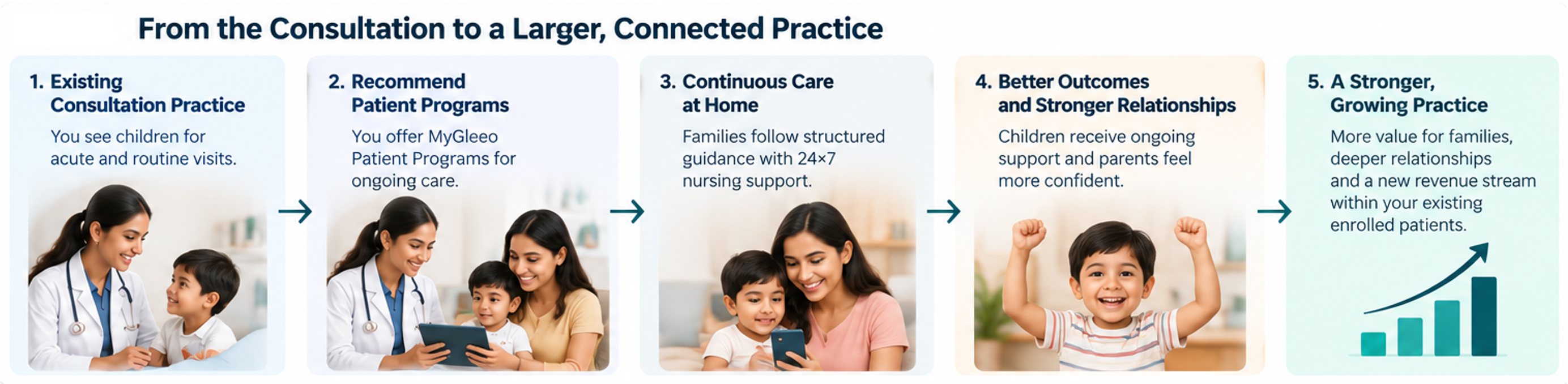
Development is a journey, not a single visit
The development journey is a good example because it naturally spans stages: newborn, infant and toddler, followed by school years and adolescence. Families’ questions change, but the trusted paediatric relationship can continue.
A practice can think in terms of age-appropriate services and support rather than waiting for each concern to become another isolated appointment. The same principle applies to vaccination, asthma and other recurring journeys.
Turn continuing care into a defined service
A paid service needs to be more than “you can message us.” It should have a clear purpose, defined duration or journey, expected support, operating process and boundaries.
Patient Programs provide that structure. The family understands what they are enrolling in; the practice understands how the service will be delivered; and the doctor is not required to personally perform every routine interaction.

How can this create revenue?
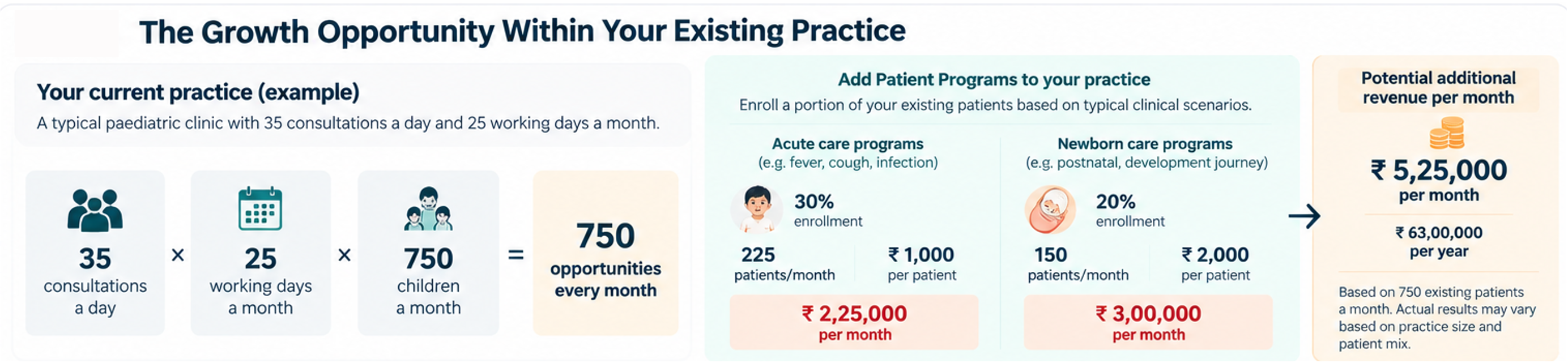
When a practice offers a valuable structured service beyond the consultation, it creates an additional revenue opportunity from patients it already serves. The economics are different from simply increasing consultation volume because the service can be supported by a care team and technology.
The objective should not be to manufacture more interactions. The objective is to organise real care needs that already exist after and between visits, and to make that service valuable enough that families choose to pay for it.
How do you avoid creating more work for the doctor?
This is the critical operating question. If every Patient Program creates another stream of calls and messages that lands directly on the paediatrician, the model has failed.
MyGleeo is designed around practice enablement: Patient Programs define the journey; care support handles routine engagement; technology keeps the journey connected; and the paediatrician remains available for the moments that need clinical expertise.
What should a practice decide before launching?
Choose one journey first
Start with a journey where the need is clear and the practice sees enough relevant patients to learn quickly.
Define the family promise
Be precise about what the family receives, for how long and how the care team and doctor participate.
Define the operating model
Decide enrolment, routine follow-up, escalation and how information reaches the practice.
Price the service clearly
The fee should correspond to a service the family can understand, rather than a vague access charge.
Measure what happens
Track enrolment, engagement, family feedback, operational effort and revenue so the model improves with experience.
A different way to think about practice growth
Practice growth is often framed as marketing: more leads, more appointments, more footfall. For an established paediatrician, there is another path - create more meaningful services for the families already in the practice.
Patient Programs are one way to operationalise that idea. They extend the practice beyond individual encounters while preserving the doctor’s clinical role and trusted relationship.
What could care beyond the consultation look like for you?
We can explore the Patient Programs that fit your practice and the families you already serve.
Book a Call →